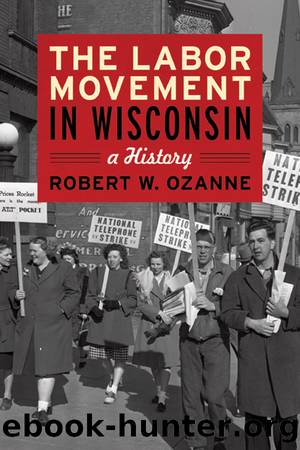
The Labor Movement in Wisconsin by Robert W. Ozanne
Author:Robert W. Ozanne
Language: eng
Format: epub
Publisher: Wisconsin Historical Society Press
Many of the state's unions have their own lobbyists. Delegations of local unions frequently come to Madison to talk to their assemblyman or senator, and most of the central bodies as well as many local union committees regularly meet with their legislators in home towns. On special occasions rallies are held on the steps of the capÃtol.
Of course, given the combination of factors which affect Wisconsin electionsânational voting trends, economic conditions, candidates' personalities, and so onâit is impossible to say what part labor's increased political effort, directed in the 1960's and 1970's mainly toward Wisconsin Democratic party candidates, has played in the success of the Democratic party over those two decades. The only demonstrable fact is that by 1977 the Democrats had gained a two-thirds majority in both state legislative branches, held all of the statewide offices, both United States senatorial seats, seven of Wisconsin's nine seats in the House of Representatives, and that all of these successful candidates had received labor's endorsement and financial support.
Similarly, many factors determine what bills are passed by a legislature, but, as noted in the previous chapter, the period from the mid-1960's through 1977 was one of the high points of labor's influence in the Wisconsin legislature, and its legislative gains were correspondingly impressive. Substantial improvements were made in unemployment compensation and workers' compensation laws. Unemployment compensation was liberalized considerably in 1960, when weekly payments were tied to a percentage of the average weekly wages up to a certain maximum. This made unnecessary the previous periodic wrangling between labor and management over the unemployment benefit level. And in 1977 the one-week waiting period required before becoming eligible for unemployment benefits was eliminated. The Wisconsin Employment Peace Act was modified to require a favorable vote by only a simply majority of the employees to implement a maintenance-of-membership contract. Major laws were passed giving municipal employees, including teachers, and state employees the collective bargaining rights which had been granted to employees in private industry by the Wagner Act in 1935.
Labor's influence also could be seen in the greater number of appointments of union members to state governing boards and advisory commissions. Since 1960 five union officialsâJacob Friedrick; Bertram McNamara, director of District 32 of the United Steelworkers of America; Raymond Majerus, director of Region 9 of the United Auto Workers; James Jesinski, president of Teamsters Local 200; and Catherine Conroy, retired CWA staff memberâhave served on the Board of Regents of the University of Wisconsin. Friedrick and McNamara both became presidents of the board. Hugh Henderson, a Steelworker staff representative, was a member of Governor Lee Dreyfus' cabinet from 1979 to 1982, serving as head of the Department of Employment Relations. He was appointed subsequently to the Labor and Industry Review Commission in the Department of Industry, Labor and Human Relations. John Schmitt sits on more public and private boards and committees than has any previous union official. Of equal importance is the number of appointees to governmental boards for whom his recommendation is important.
As is
Download
This site does not store any files on its server. We only index and link to content provided by other sites. Please contact the content providers to delete copyright contents if any and email us, we'll remove relevant links or contents immediately.
The Vikings: Conquering England, France, and Ireland by Wernick Robert(84381)
Ali Pasha, Lion of Ioannina by Eugenia Russell & Eugenia Russell(40318)
The Conquerors (The Winning of America Series Book 3) by Eckert Allan W(37983)
The Vikings: Discoverers of a New World by Wernick Robert(37006)
Cecilia; Or, Memoirs of an Heiress — Volume 1 by Fanny Burney(32636)
Cecilia; Or, Memoirs of an Heiress — Volume 2 by Fanny Burney(32010)
Cecilia; Or, Memoirs of an Heiress — Volume 3 by Fanny Burney(31996)
Empire of the Sikhs by Patwant Singh(23135)
The Secret History by Donna Tartt(19294)
Hans Sturm: A Soldier's Odyssey on the Eastern Front by Gordon Williamson(18649)
Cat's cradle by Kurt Vonnegut(15441)
Pimp by Iceberg Slim(14666)
Sapiens: A Brief History of Humankind by Yuval Noah Harari(14460)
Norse Mythology by Gaiman Neil(13458)
Talking to Strangers by Malcolm Gladwell(13439)
Leonardo da Vinci by Walter Isaacson(13411)
4 3 2 1: A Novel by Paul Auster(12511)
Underground: A Human History of the Worlds Beneath Our Feet by Will Hunt(12145)
The Radium Girls by Kate Moore(12093)
